
Ultrafine bubbles are attracting growing attention in fields ranging from industry to everyday life. Television commercials and other media have raised awareness of them as a “cutting-edge cleaning technology”, but this technology is far more than a passing trend. In agriculture, healthcare, environmental infrastructure and other fields, ultrafine bubbles are drawing expectations from around the world as an “innovative technology from Japan” that can help build a sustainable society in line with the Sustainable Development Goals (SDGs).
This article offers a clear explanation of the scientific mechanisms behind ultrafine bubbles, which many people have heard of but few truly understand, and of their wide-ranging potential.
What Are Ultrafine Bubbles? Bubbles Too Small to See
The bubbles we see every day, such as those in carbonated drinks or bath water, rise to the surface and disappear soon after they form. Ultrafine bubbles, by contrast, are extremely small bubbles less than 1 micrometer (one-thousandth of a millimeter) in diameter. Because they are measured in nanometers, water containing them stays clear, and they cannot be seen with the naked eye.
Their Defining Feature: Almost No Buoyancy
The most distinctive feature of ultrafine bubbles is that they have almost no buoyancy. Instead of rising to the surface and disappearing like ordinary bubbles, they keep moving through Brownian motion (the random movement of fine particles) and, depending on the environment, can remain in water for several months or more.
International standards for the definition and measurement of this technology are being developed through the International Organization for Standardization (ISO), with Japan taking the lead.
| Item | Ordinary bubbles (carbonated drinks, baths, etc.) | Ultrafine bubbles |
|---|---|---|
| Bubble diameter | Large enough to see | Less than 1 micrometer |
| Visibility | Visible to the naked eye | Water stays clear; bubbles are invisible |
| Buoyancy | Rise and disappear quickly | Almost no buoyancy; rarely rise to the surface |
| Persistence in water | Rise and disappear soon after forming | Several months or more, depending on the environment |
| Behavior in water | Rise to the surface and disappear | Keep drifting through Brownian motion |
A Cleaning Mechanism That May Reduce the Use of Chemicals
The main reason ultrafine bubbles are valued as an environmentally friendly technology is their cleaning action. Two properties of the bubbles, their size and their electrical charge, explain why they may help reduce the use of detergents and other chemicals.
1. Adsorption Through Negative Charge
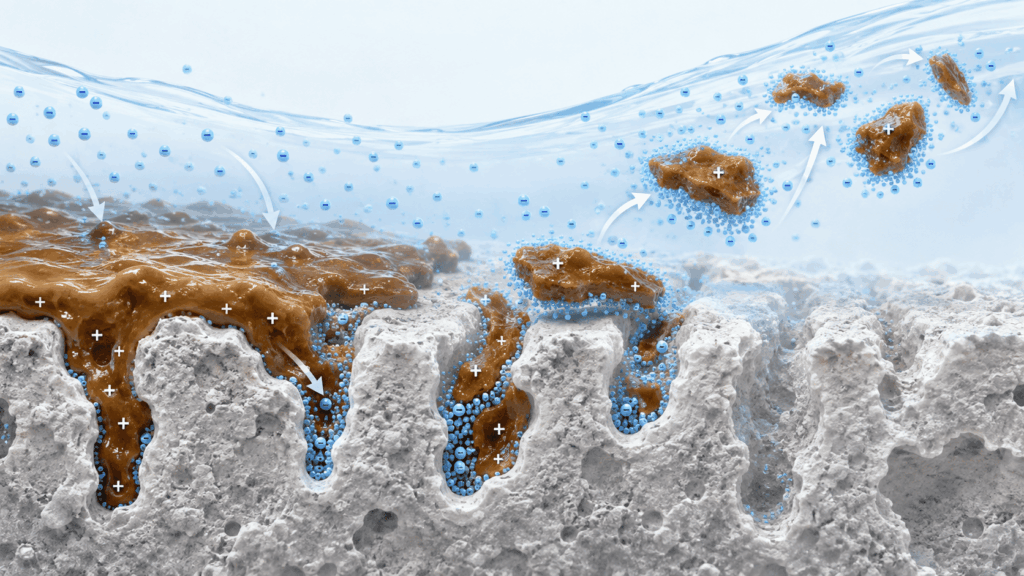
Ultrafine bubbles in water carry a negative electrical charge on their surface, while many oily soils and organic substances carry a positive charge. This difference in charge causes the bubbles to adhere to soils.
2. Penetration into Gaps and Lifting of Soils
Ultrafine bubbles are smaller than the fine gaps and irregularities in a material’s surface, so they can reach deep into areas that ordinary water cannot. Once inside these gaps, the bubbles attract soils through electrical force, gently lift them away from the surface and wash them off.
| Cleaning action | How it works | Expected benefits |
|---|---|---|
| Adsorption through negative charge | Negatively charged bubbles attract positively charged oily soils and organic substances | Captures soils efficiently |
| Penetration into gaps and lifting of soils | Smaller than fine surface irregularities, the bubbles reach deep areas that ordinary water cannot | Can help reduce the use of detergents and chemicals |
Ultrafine Bubbles Transforming a Wide Range of Industries
Applications in household showerheads and washing machines are the most familiar, but industry is adopting the technology on an even larger scale. Here are three representative fields.
Agriculture and Fisheries: Higher Productivity and Vitality
Research and practical applications are advancing in which oxygen-rich ultrafine bubble water is supplied to crops to stimulate root cells and promote growth. In aquaculture, the technology is also helping to improve the survival rate of fish and shellfish and keep them fresh.
Environment and Infrastructure: Eco-Friendly Cleaning with Fewer Chemicals
Ultrafine bubble water is increasingly being used to clean public facilities on expressways and large plants. Because it can help reduce the use of strong detergents and chemicals, it serves as “environmentally harmonious infrastructure” that limits the environmental impact of wastewater.
Healthcare and Nursing Care: Gentle Hygiene Management
Because ultrafine bubbles can clean down to fine wrinkles while minimizing irritation to the skin, they are used to support bathing and cleansing at medical institutions and nursing care facilities. They are valued for reducing the burden on care recipients while also improving work efficiency.
| Field | Main applications | Expected benefits |
|---|---|---|
| Agriculture and fisheries | Irrigation of crops; rearing water for aquaculture | Faster growth through root activation, higher survival rates, longer freshness |
| Environment and infrastructure | Cleaning of public facilities and large plants | Less use of detergents and chemicals; lower environmental impact of wastewater |
| Healthcare and nursing care | Bathing and cleansing support at medical institutions and nursing care facilities | Hygiene management that is gentle on the skin; less caregiving burden |

Summary: Unlocking the Potential of Water for a Sustainable Future
Ultrafine bubble technology unlocks the potential of water, a familiar resource we use every day. It helps conserve resources, reduce environmental impact and make people’s lives more comfortable. This tiny-bubble technology, in which Japan leads the world, holds an important key to the environmental management and efficiency that society will increasingly demand.
Shibata Co., Ltd. will continue to follow the latest technology trends that support future lifestyles and industries, and contribute to building a prosperous society.
About the Author
Nakamura, Fine Bubble Division, Shibata Co., Ltd.