

What Are Ultrafine Bubbles?
Invisible, Microscopic Bubbles That Remain in Water for Extended Periods.
Ultrafine bubbles (UFBs) are extremely small bubbles with a diameter of less than 1 μm. Although they have been called “nanobubbles” or “micro-nanobubbles,” the formal term defined in ISO 20480-1 by the International Organization for Standardization is “ultrafine bubbles.”
This name is a registered trademark of FBIA, and its use for products is subject to the prescribed assessment.
“ファインバブル” (Fine Bubble), “ウルトラファインバブル” (Ultra Fine Bubble) and “FINE BUBBLE” are registered trademarks of the Fine Bubble Industries Association.
As a full member of FBIA, Shibata can support the trademark-use application and assessment process free of charge.
FBIA Registered Trademark Use Program
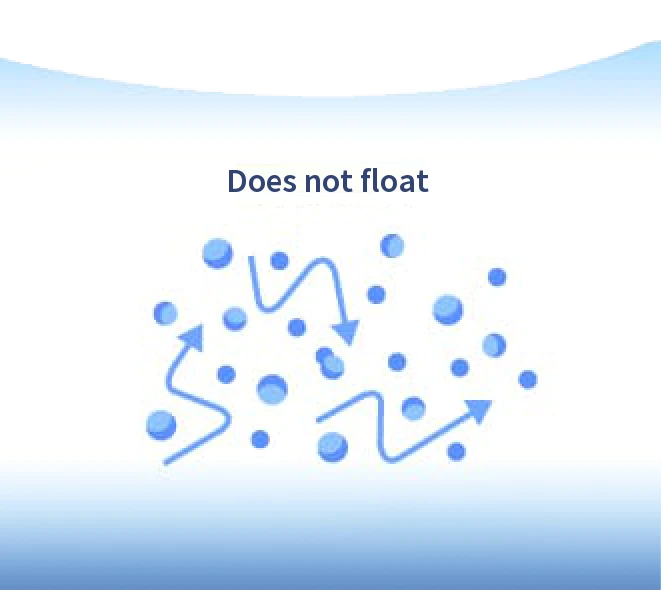
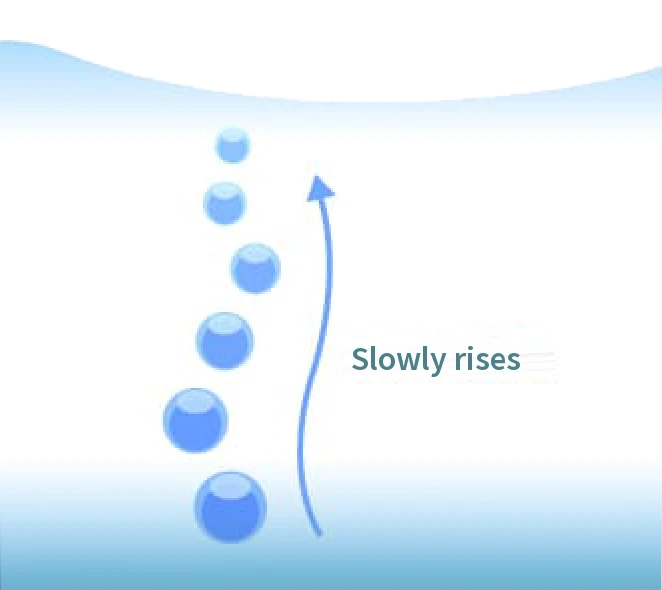
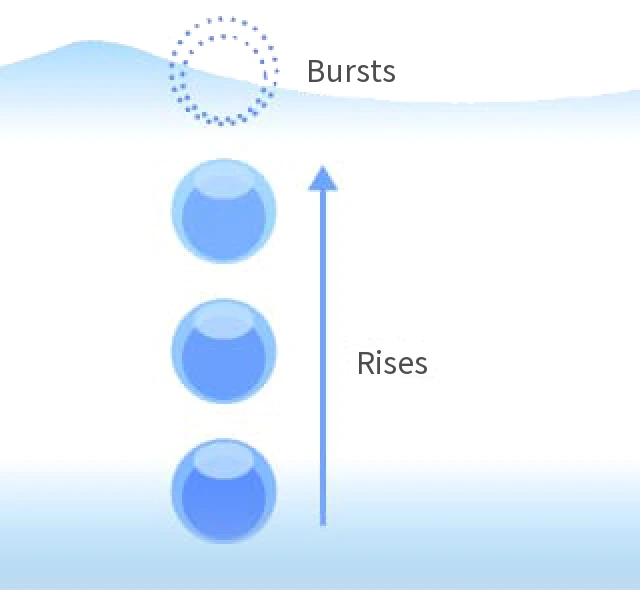
| Bubble Diameter Objects of Comparable Size |
Less than 1 μm
|
1 μm to less than 100 μm
|
100 μm or larger
|
|---|---|---|---|
| Visible to the Naked Eye |
No (clear and colorless) |
Yes (cloudy white) |
Yes |
| Behavior in Water |
Remain in water for long periods (clear and colorless) Lifetimes of weeks to months Viscous effects dominate over buoyancy |
Rise very slowly Approximately 3 mm/min for a bubble 10 μm in diameter (about 1/2000 of the rise speed of millibubbles) |
Rise rapidly Approximately 5–6 m/min for a bubble 1 mm in diameter |
|
Their extremely small size means low buoyancy, so they remain in the water without rising or disappearing. |
Shrink while slowly rising due to buoyancy. |
Rise immediately after they are generated. |
Six Characteristics
Six Fundamental Properties of UFBs
UFBs have distinctive physical and chemical properties not found in ordinary bubbles. In combination, these properties are driving applications in a wide range of fields, particularly cleaning.
-
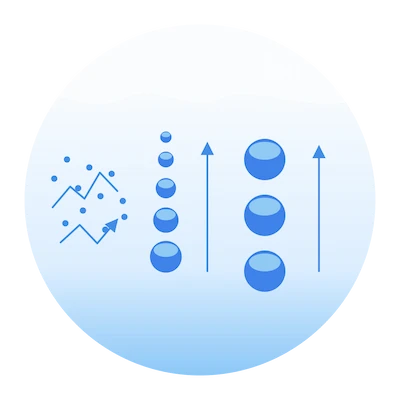
Stable in Water
Suitable for Storage and Transport through Pipes
UFBs remain stable in water for weeks to months without rising to the surface. UFB water can be temporarily stored in tanks and transported using pumps and piping, expanding its practical uses on site.
-
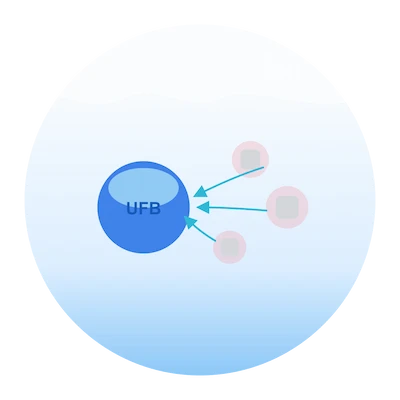
Hydrophobicity (Affinity for Oil)
Cleaning Oily Contaminants
UFBs are hydrophobic and have an affinity for oil, attracting molecules in oily contaminants. This makes them useful for removing residues such as machining oils and cooking oils.
-
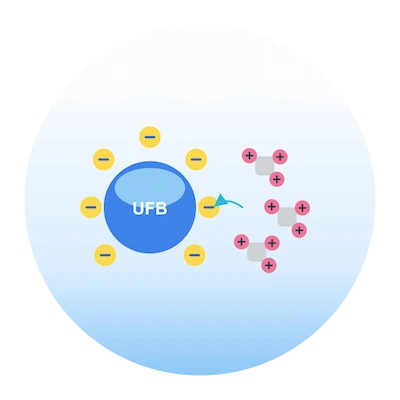
Negatively Charged Surfaces
Removing Positively Charged Contaminants
The negatively charged surfaces of UFBs attract and adsorb positively charged contaminant particles, such as dust and fine particles. This physical adsorption enables cleaning without relying on chemicals.
-
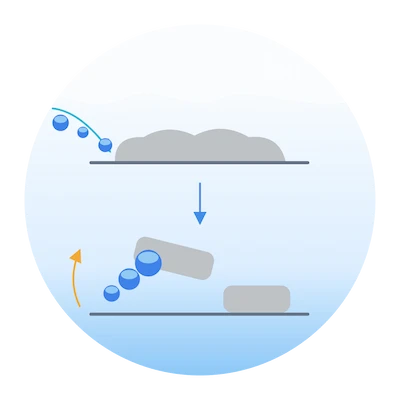
Lift-Off (“Jacking-Up”) Effect
Removing Adhered Deposits
Nanoscale UFBs enter gaps between deposits and the underlying surface, lifting and detaching the contaminants from below. This is effective for removing urine scale and mineral scale inside pipes, providing physical cleaning without relying on chemicals.
-
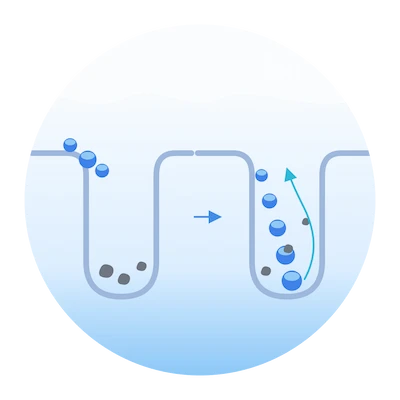
Improved Penetration
Cleaning Fine Gaps and Uneven Surfaces
Water containing UFBs has lower surface tension, allowing it to penetrate gaps between fibers and fine surface irregularities. This enables efficient cleaning in areas that ordinary rinsing with water cannot reach.
-
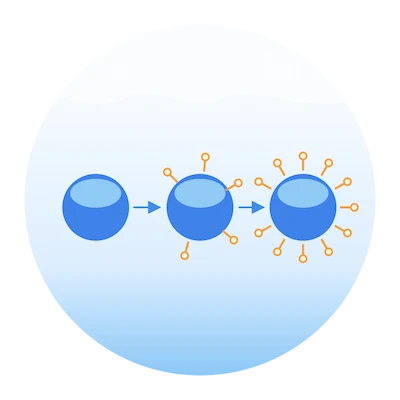
Surfactant Adsorption onto Bubble Surfaces
Boosting Detergent Performance and Rinsing
Surfactants—the active cleaning ingredients in detergents—adsorb onto UFB surfaces and carry cleaning agents throughout the contaminated area. This boosts detergent performance and improves rinsing efficiency, helping reduce detergent and water use.
How UFBs Are Generated
UFB Generation Methods and the Technical Advantages of SHIBATA ENGINE
UFB generators fall into three broad categories. SHIBATA ENGINE belongs to the nozzle-type category requiring no gas supply—the easiest type to integrate—and delivers high performance through its proprietary patented structure.
-
Type 1
Equipment-Based System
Generates UFBs from an External Gas Supply
- Gas is supplied externally.
- The supplied gas is broken down into fine bubbles, generating MBs and UFBs simultaneously.
- MBs are removed by flotation separation.
- The resulting UFB water is used after separation.
- Recirculation (batch operation) is required.
- Suitable for achieving high fine bubble concentrations.
- Power supply: Required
- Gas supply: Required
- Ease of integration: △
-
Type 2
Nozzle Type (with Gas Supply)
Generates UFBs from an External Gas Supply
- Gas is supplied externally.
- The supplied gas is broken down into fine bubbles, generating MBs and UFBs simultaneously.
- No power supply is needed, but a gas supply is required.
- Smaller and easier to integrate than an equipment-based system.
- Recirculation (batch operation) is required.
- A more compact, easier-to-integrate approach than equipment-based systems.
- Power supply: Not required
- Gas supply: Required
- Ease of integration: 〇
-
SHIBATA ENGINE
Nozzle Type (No Gas Supply Required)
Generates UFBs from Dissolved Gas
- Uses cavitation with a proprietary patented structure.
- Generates UFBs from dissolved gas using water pressure alone.
- No MB separation step is required.
- Connects directly to piping for single-pass generation.
- Supports both single-pass and recirculating operation.
- Smaller and easier to integrate than equipment-based systems.
- The easiest type to integrate, with one of the industry's strongest application track records.
- Power supply: Not required
- Gas supply: Not required
- Ease of integration: ◎
Applications
Expanding Applications for UFB Technology
UFBs have the potential to deliver benefits wherever water is used. With cleaning as a core application, their use is expanding rapidly across manufacturing, building management, food, beauty, agriculture, fisheries and healthcare.
-

Cleaning
Factory lines · Kitchens · Toilets · Washing machines · Car washing · Pipework
-

Agriculture & Livestock
Hydroponics · Irrigation · Germination promotion
-

Food
Freshness preservation · Oxidation prevention · Food washing · Hygiene management
-
Beauty & Healthcare
Showers · Bathing facilities · Cosmetic removal · Assisted bathing
-

Industry
Semiconductor cleaning · Chiller water purification · Metal parts cleaning · Coolants
-

Fisheries & Aquaculture
Improved aquaculture conditions · Water purification · Growth promotion
-

Building Management
UFB integration into water storage tanks · Drainpipe maintenance
-

Marine & Other Applications
Cruiser faucets · Dental care · Energy